A usable commercial LED lighting RFQ gives every supplier the same scope, format and assumptions to price. It should cover the destination market and site, drawings, fixture schedule, operating environment, supply and controls, required documents, sample acceptance, quantities, packaging, delivery requirements and a comparable quotation template. Ask each supplier to confirm compliance and list exceptions in writing; request confirmation of the capabilities needed for your project.
Start with destination market and site conditions
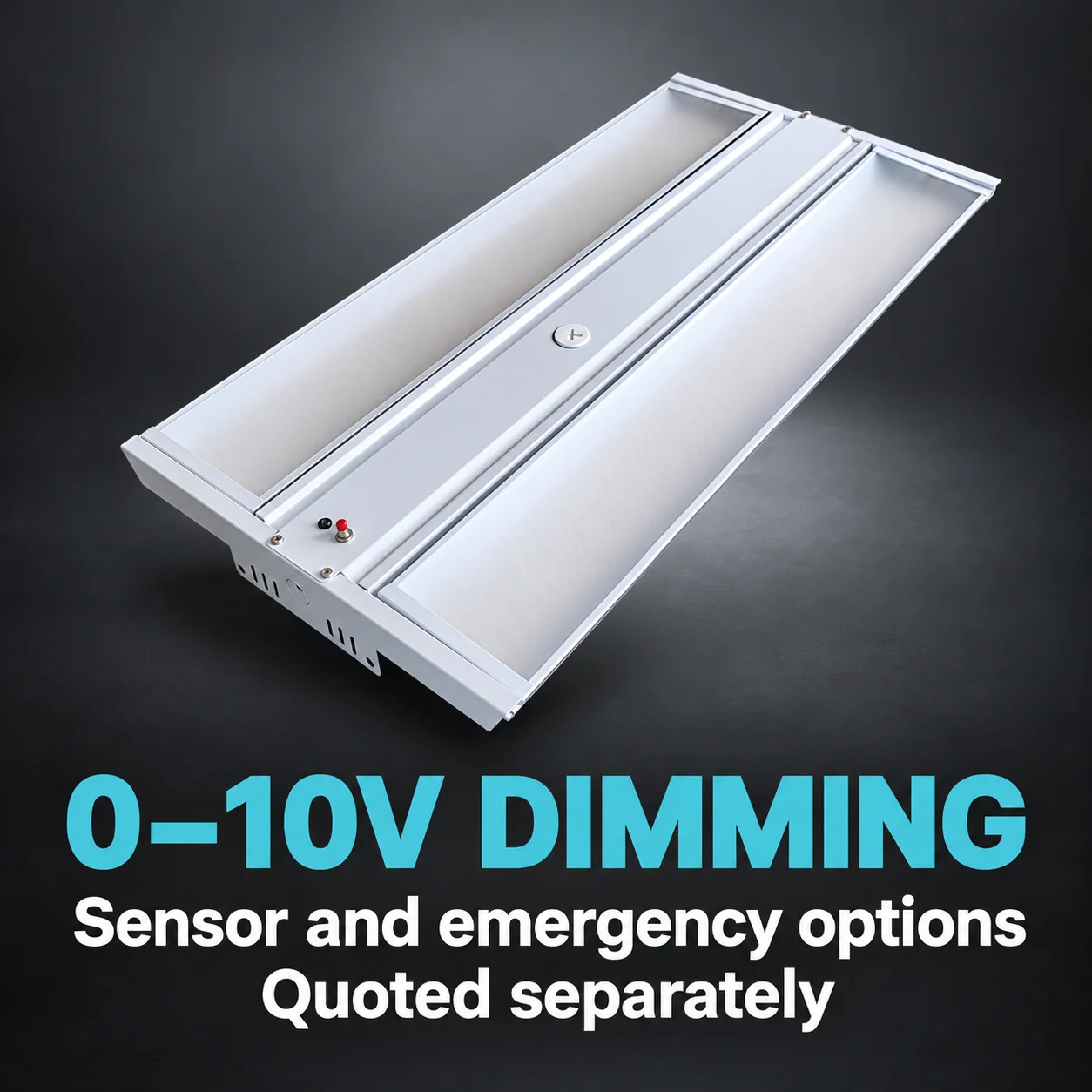
State where the products will be installed and who will approve them. Provide the project address or at least country/city, indoor or outdoor location, mounting height, ambient temperature range, humidity, dust or washdown exposure, and any corrosive or coastal conditions. For controls, identify the planned protocol, dimming method, emergency operation and whether sensors are integral or separate.
Ask: “Which product versions do you recommend for this environment, and what are their limits?” Also ask for the document pack required for the destination market—datasheets, photometric files, installation instructions and applicable declarations or test reports. Require written confirmation that documents are current and match the quoted model.
Issue drawings and a line-item fixture schedule
Attach lighting layouts, reflected ceiling plans, sections and control-zone drawings. If final drawings are not ready, mark them “for pricing” and give a revision number. The fixture schedule should be a sortable table with: type tag, area/room, description, quantity, mounting method, finish, performance targets, CCT, CRI, beam angle, dimming/control requirement, accessories and emergency requirement. Leave numeric performance values for the buyer or specifier to set; do not let suppliers substitute unapproved equivalents.
Ask suppliers to return the schedule with a column for model, deviations and remarks. A quote that references only “LED panel” or “high bay” is not comparable. Decision criterion: can you match every line to a quoted model, accessory and document set?
Define supply, controls and sample acceptance
Clarify what is in scope: luminaire, driver, mounting kit, sensors, emergency battery, wiring terminations and commissioning support. For controls, state who supplies and programs the system, and whether compatibility testing is required. Ask for written confirmation of interface compatibility rather than a verbal assurance.
Set a sample process before quoting: pre-production sample, finish and label sample, photometric test report if available, and an approval form. Define acceptance criteria—visual inspection, label content, dimensional check, function test and packaging check. State who pays sample freight and whether approved samples are retained as a reference. Ask the supplier to confirm what a sample represents and what may change in mass production.
Quantities, packaging and delivery requirements
Give quantities by phase, plus a separate spares allowance. Ask for MOQ, carton quantity, pallet configuration, label format, barcode requirement and any mixed-carton limits. Specify packaging tests or handling conditions only if your project requires them, and ask suppliers to confirm what they can meet.
State delivery destination, required-on-site date, acceptable partial shipments and Incoterm. Request a packing list format and export documents. For comparable quotations, require one template: line item, unit price, tooling or sample charge, packaging, freight, duties, lead time, quote validity, payment terms, warranty terms and explicit exclusions. Ask for lead time to be stated in writing, not implied.
Buyer checklist before you send the RFQ
- Destination market, site address, indoor/outdoor use and environmental limits.
- Current drawings with revision number and control zones.
- Fixture schedule with tags, quantities, performance targets and accessories.
- Supply boundary: drivers, sensors, emergency, mounting and commissioning.
- Document list and requirement for written confirmation of model match.
- Sample scope, approval criteria and retention terms.
- Quantities by phase, spares, MOQ and packaging/label requirements.
- Delivery address, required date, Incoterm and partial-shipment rule.
- Quotation template with deviations, exclusions, validity and lead time.
- Deadline for questions and a named contact for clarifications.
FAQs
What is the minimum information for a usable commercial LED lighting RFQ?
At minimum: destination market, drawings or a tagged fixture schedule, quantities, delivery requirements and a quotation template. Add environment, controls, documents and sample terms so quotes can be compared.
Should I send an RFQ before drawings are final?
Yes, if you label the package “for pricing” with a revision number. Ask suppliers to state assumptions and exclusions in writing, then reissue the final drawings before purchase order.
How do I compare LED lighting quotations fairly?
Normalize every line to the same fixture tag, accessory set, document pack, packaging and delivery basis. Require deviations and exclusions to be listed, not buried in notes.
Send a project brief to Noon Lighting
Share your destination market, drawings, fixture schedule, quantities and delivery requirements with Noon Lighting. Use the brief to identify the RFQ inputs that need clarification. Product suitability, certifications, lead times, prices and warranty terms must be confirmed in writing by the supplier for your specific project.

 EN




 Hot News