Back-of-house lighting gets specified last and used hardest. Equipment rooms, service corridors, and storage areas are judged by staff who are carrying something, reading a label, or looking for a valve — not by anyone admiring the ceiling. That makes wraparound fixtures a practical choice, but only when distribution, lens design, and mounting space are matched to the room rather than to a line item.
Distribution and side throw
In a narrow aisle lined with shelving or pipework, review where a wide symmetric distribution puts light. Check for glare at typical viewing angles and shadows cast by the shelves or pipes. Ask how much illumination reaches vertical surfaces and whether a side-throw or asymmetric version suits runs mounted close to a wall. In open storage rooms, even floor coverage usually matters more than vertical brightness, while in equipment aisles the reverse is often true.
Form and lens access
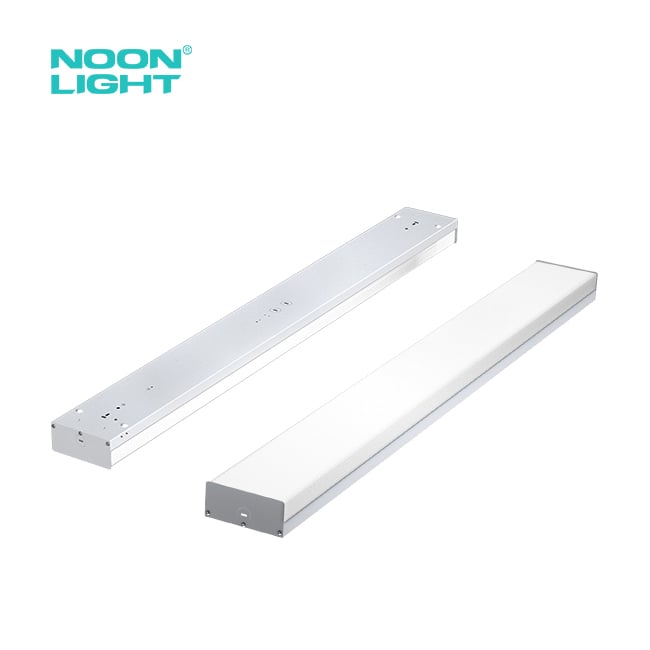
Wraparounds differ in body width, end-cap design, and how the lens is retained. Where maintenance is infrequent and access equipment is awkward, the deciding feature is often how the lens opens: hinged, slide-out, or lift-and-shift. Ask how the lens is removed, cleaned, and refitted. Check the required clearance and access equipment with the maintenance team.
Installation space
Check what sits above the ceiling before choosing surface, pendant, or recessed mounting. Joist direction, ductwork, and sprinkler runs decide whether a shallow body matters. In a tight room, a narrower housing with suitable distribution can be the difference between fitting the layout and re-routing services.
Specification confirmation checklist
- Room dimensions, mounting height, and aisle width.
- Mounting type and clearance above the fixture.
- Distribution needed, and whether vertical illumination is part of the brief.
- Lens material, retention method, and cleaning expectations.
- Ambient conditions — dust, moisture, temperature — described to the supplier for review.
- Who maintains the fixtures, and with what access equipment.
Any decision involving wet locations, hazardous dust, or regulated spaces should be reviewed with the project designer or a qualified contractor before ordering. For a room-by-room comparison, start with the LED wraparound lights range and send your room list to our team.

 EN



 Hot News